In Istanbul’s Hollywood-smile landscape, endodontics is unusual. Most clinics extract teeth, place implants and earn more for it. Dr. Cansu Öztürk has chosen another route: endodontist with specialist training to ESE and AAE standards, with microscope-led root canal and retreatment as everyday work. Before we extract a tooth, we ask whether we can save it. In about seven cases out of ten, the answer is yes.
Dentistry has a clear biological hierarchy. A healthy natural tooth is always the first option. When damage occurs, you choose conservatively — filling, then endodontics, then prosthetic restoration on the natural tooth, and only then extraction and implant. This sequence is in mainstream UK dental guidance and in international endodontic consensus (ESE, AAE). It is the reason experienced clinicians do not extract first.
Caries-free · minimally invasive filling
Root canal · retreatment · tooth stays
A microscope-led root canal takes ninety to one hundred and twenty minutes and earns a smile-makeover practice less than a crown or veneer. In one hour, a dentist can either irrigate a single canal — or prepare two teeth for crowns, convert the patient and accept the next case. In the maths of sixteen veneers versus two endo sittings, the choice for a commercial clinic is trivial. That is why “endodontics” almost never appears in the smile-makeover advertising.
Endodontics is a three-year postgraduate qualification. In Turkey there are roughly two to three hundred dentists with this specialist training — out of more than thirty thousand active dentists. Those who invest three years tend to stay in university clinics or specialist practices, not in tourist-volume smile clinics. Dr. Öztürk is one of the few who, after heading the Department of Endodontics at Yeni Yüzyıl University (2016–2019), moved into private boutique practice without abandoning the discipline.
If a Turkish clinic proposes extraction before a retreatment option has been considered, ask the questions. Is the practice endo-capable? Is there an operating microscope on site? Has the treating clinician completed postgraduate training in endodontics? At GC Clinic the answer is yes, yes and yes — which is why we save teeth that other practices would extract.
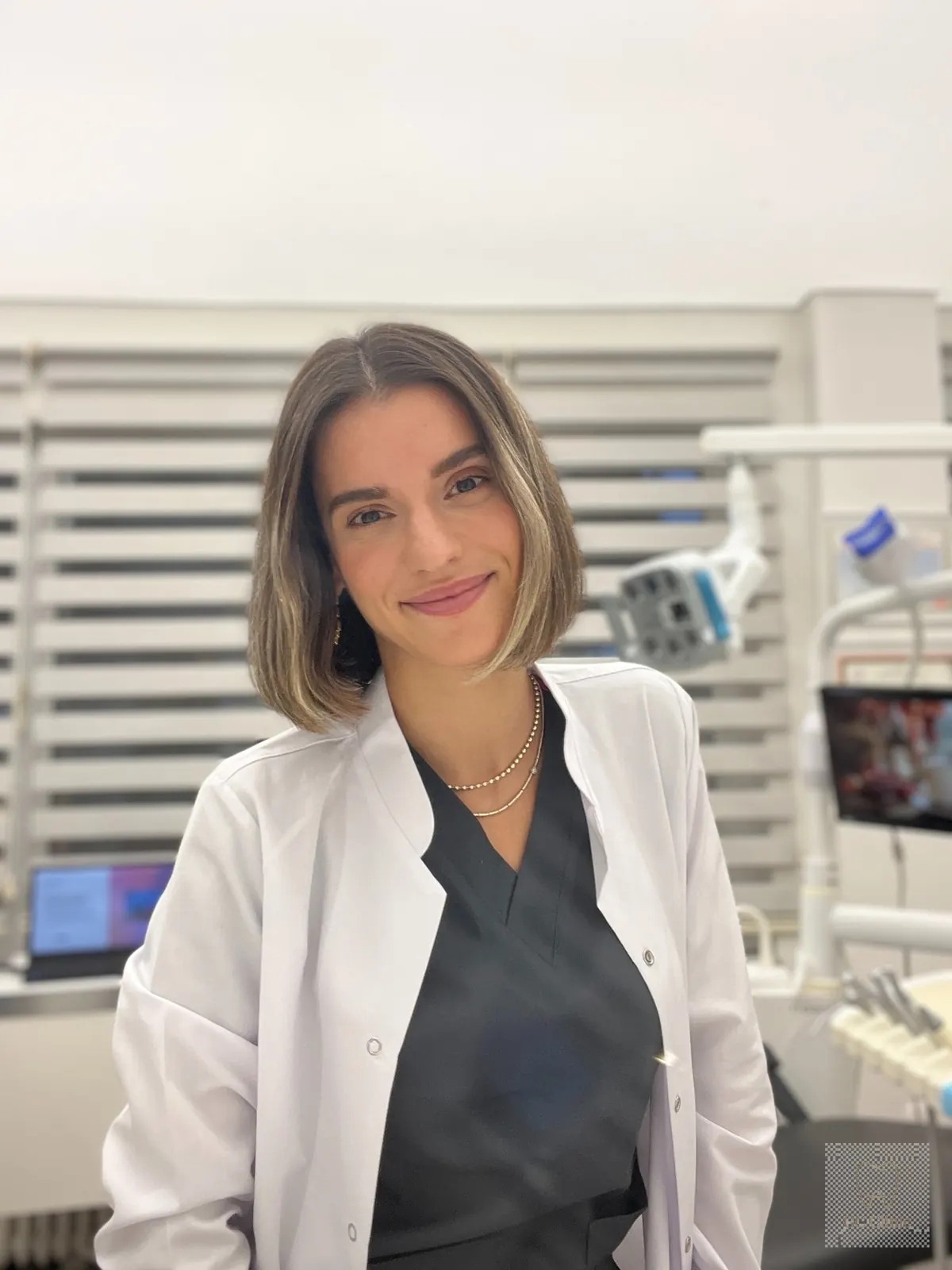
Dr. Cansu Öztürk, DDS, MSc — endodontist with specialist training. Former Assistant Professor and Head of the Department of Endodontics, Yeni Yüzyıl University, Istanbul (2016–2019). Member of the European Society of Endodontology (ESE), the American Association of Endodontists (AAE) and the Turkish Society of Endodontology (TED).
In the United Kingdom, the title “endodontist with specialist training” is reserved for dentists on the GDC Specialist List. Dr. Öztürk’s specialism is Turkish-trained and she is not on the UK GDC Specialist List. The formulation used throughout this site — “endodontist with specialist training” — reflects both her credentials and UK advertising standards.
Portrait — clinical work
DDS — Ege University Faculty of Dentistry · 2005–2010
MSc / specialist training in Endodontics — Marmara University · 2012–2016. Studied under Prof. Dr. Semih Özbayrak. Research focus: stem-cell applications and probiotics in endodontics, peer-reviewed publications.
Assistant Professor & Head of Department of Endodontics — Yeni Yüzyıl University · 2016–2019. Course leadership, doctoral supervision, clinical focus on micro-endodontics and retreatment.
Continuing professional education — micro-endodontics training at European university clinics; certified user of Zeiss OPMI operating microscope.
Memberships — ESE · AAE · TED · Istanbul Chamber of Dentists.
Cold/hot sensitivity and throbbing pain. The nerve is inflamed; the tooth itself is structurally intact. Root canal treatment is the standard answer.
Chronic peri-apical inflammation, often without symptoms. Eighty to ninety-five per cent of cases can be saved with microscope endo. Extraction is not the first option.
An earlier root canal is failing. Under microscope, an overlooked canal, a perforation or a fractured instrument can usually be corrected.
01 · Pulpitis
02 · Apical lesion
03 · Retreatment
04 · Four-canal molar
05 · Perforation
06 · Calcified canals
Cone-beam CT shows the anatomy in three dimensions — accessory canals, peri-apical lesions, fractured instruments. Vitality testing tells us whether the nerve is alive.
The dam isolates the tooth from the oral environment. Zeiss OPMI microscope at 4× to 25× magnification allows precision work that is not possible with the naked eye.
Rotary nickel-titanium files (ProTaper Gold, WaveOne) shape the canals gently. Sodium hypochlorite irrigation disrupts the bacterial biofilm — that is the actual healing step.
The cleaned canal is sealed three-dimensionally with Guttaflow / BC Sealer. The aim is a bacteria-tight seal to the apex.
The tooth is restored with a bonded composite or — when substance loss is large — a crown. Surgical procedures (complex implants, sinus lift, periodontology) are led by Dr. Engin Bakkal. Crowns and veneers remain in Dr. Öztürk’s clinical remit.
Root canal treatment is one of the best-documented procedures in dentistry. The numbers are clear — and they contradict the “extract immediately” narrative.
Microscope-led root canal at five years. Sources: Ng et al. 2011 (Int Endod J); Torabinejad et al. 2007 (JADA).
When prior endo has failed; with microscope access. Source: ESE consensus 2006, updated 2019.
10 yr+
Free endodontic assessment, signed by Dr. Öztürk. In writing, in under four hours. Without an extraction-first bias.
Next step