GC Clinic LabworX is our in-house dental laboratory. It is a separate legal entity that works exclusively for GC Clinic — which means every crown, veneer, bridge, abutment and full-arch restoration designed in our chair is milled, pressed, fired, glazed and quality-checked in the same building, by the same people, for one patient at a time. The clinician walks down the corridor, not across the city.
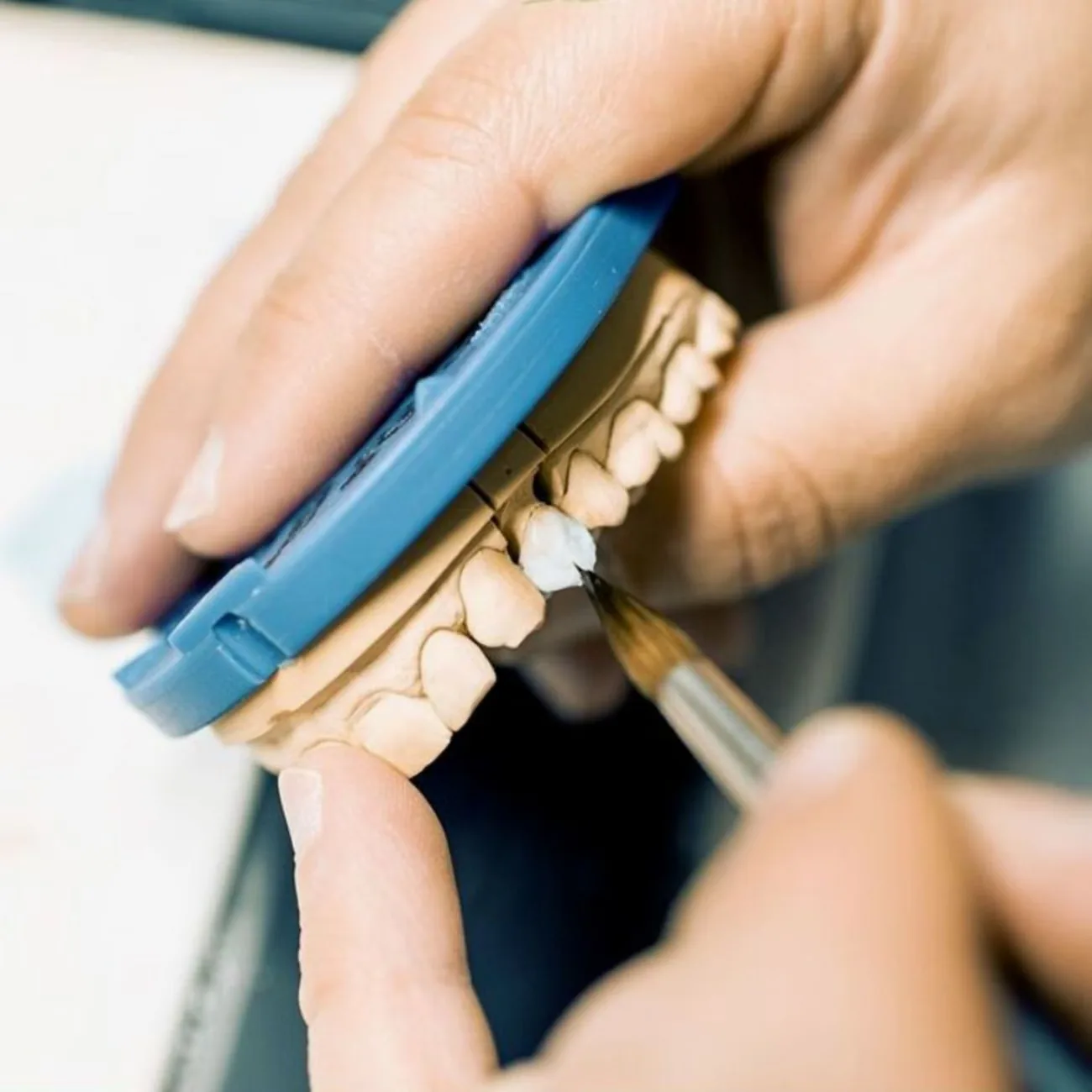
The patient-facing benefit of an in-house dental laboratory is not the equipment list. It is the loop — clinician, technician, patient — staying short. Short loops produce restorations that fit, look right, and survive bite forces because the people responsible never lose context.
A digital impression taken in the morning can be designed, milled or pressed, fired and glazed the same day. We do not promise same-visit delivery for every case — that would be a sales claim, not clinical practice. We do promise that the case never sits in a courier bag or a queue.
Before a crown leaves the lab bench it is checked by the technician who made it and the clinician who will seat it — in the same room, against the patient’s photographs, study models, and shade notes. Adjustments take minutes, not days.
Why an in-house lab actually matters
We are a boutique laboratory inside a boutique clinic — not an industrial milling centre. The equipment list is deliberate, the materials are mainstream, and nothing on this page is here for marketing reasons.
Intraoral scans are designed in exocad-class CAD software and milled on dental CNC units (Roland DGShape-class wet/dry milling). Zirconia restorations are processed in dedicated sintering furnaces; PMMA mock-ups and try-ins are produced on the same workflow.
For lithium-disilicate veneers and crowns we use IPS e.max press ingots in a dedicated press oven, with hand-layering for cases where translucency and incisal characterisation require it. Glazing and staining is done on the same bench by the same ceramist.
What is in the lab
After preparation, an intraoral scan is taken in the operatory. Shade, photography, occlusion notes and patient preferences are written into the case file by the treating clinician — not by a coordinator, not on a form. The file walks to the lab with the clinician’s voice on it.
The technician designs the restoration in CAD software, or builds an analog wax-up where the indication calls for it. The design is reviewed against patient photographs, smile line, lip dynamics and the agreed plan. Changes are made before any material is cut.
Depending on the material and indication, the restoration is milled from a zirconia disc, pressed from an e.max ingot, or printed for try-in mock-ups. Batch numbers are logged at this step against your case file.
How a case moves through LabworX
Outsourced dental laboratories are a perfectly reasonable model and the global industry runs on them. We choose not to use one because, for the kinds of cases we treat, the loop length matters more than the cost savings. The table below describes the practical difference — not a judgement of either model.
| Dimension | Outsourced lab workflow | GC Clinic LabworX |
|---|---|---|
| Turnaround between scan and try-in | Several days to two weeks, depending on courier and queue | Hours to one to two days, depending on indication |
| Communication channel | Written prescription, photographs, occasional phone call | Clinician and technician in the same room, same case, same hour |
| Quality control before delivery | Lab technician QC, clinician inspects on delivery | Technician QC plus clinician review on the bench before try-in |
| Materials traceability to the patient | Depends on lab paperwork transferred to clinic | Logged in your case file by batch and lot, given to you in writing |
| Remake handling | Re-scan, re-courier, re-queue | Adjusted or remade in the same building, same case file |
LabworX is involved in every restorative and prosthetic case we treat. Below is a plain list of what the lab actually produces for each treatment line — useful if you want to understand where the lab sits in your specific plan.
After osseointegration, LabworX produces the patient-specific abutment and the final implant-supported crown — zirconia or lithium-disilicate, depending on position and load. Batch numbers and abutment specification go into your case file.
LabworX produces the immediate-load provisional bridge for surgery day and the definitive full-arch bridge once healing is complete. Designed against the patient’s facial photography, vertical dimension and lip support.
What LabworX makes for which treatment
LabworX is run by an in-house ceramist who works only on GC Clinic cases. The lab is a separate legal entity for commercial and regulatory reasons, but it does not take cases from other clinics and does not function as a contract laboratory. You meet the team in the same building as your operatory.
LabworX operates under the relevant Turkish dental laboratory regulations and uses materials supplied by manufacturers whose products are CE-marked and documented under their own regulatory frameworks (Ivoclar, Zirkonzahn-class suppliers, Nobel Biocare). Specific manufacturer documentation for the materials used in your case is available on request as part of your treatment dossier.
Yes. We supply you with the written case file, batch and lot numbers, the implant system used and the manufacturer documentation. If your dentist at home needs to communicate directly with LabworX about a restoration, that is arranged through the clinic — and almost always handled in writing for clarity.
Three honest questions about an in-house lab
At seat-and-document, the case file closes with: photographs of the seated restoration, batch and lot numbers of every material used, the implant system and surgical record where applicable, and the warranty terms in writing. Our standard warranty positions are: ten years on the implant fixture, five years on crowns and veneers, two years on endodontic work, and one year on soft-tissue procedures. Warranty is subject to the patient following the documented home-care and follow-up protocol — the clinical reason for this is on the same page as the terms.
Because LabworX is in the same building, your case file does not depend on a third party retaining records. Batch and lot numbers, manufacturer documentation and the photograph of the seated restoration are held in the clinic record and supplied to you in writing.
Warranty coverage depends on treatment type, the materials selected and the patient’s adherence to documented home-care and recall protocols. Exact warranty terms for your case are set out in your written treatment plan.
Warranty and traceability
If you would like a written treatment plan that includes the lab-side detail — materials, batch policy, turnaround, and traceability — share your photographs, panoramic film or recent reports. We respond on WhatsApp within 30 minutes during clinic hours, and the written plan is with you within four hours of complete records.
Plan your case with LabworX in mind